

July 31, 2026
Protecting Our Oasis: A Reflection on the Woods in Conversation with Jacqueline Anderson and Amanda Losness-Ross
By: Rachel Erdmann
Tucked behind the Adler Arts Center lies a wooded area along the Des Plaines River that connects to Adler Park. Looking out from the sunporch at the back of the Adler building, one can see a long clearing flanked by two studios and twining trees. Teaming with life, the woods provide shade in the summer, trails to walk on, fresh air, and an atmosphere of beauty and serenity that can make one feel as if they have stepped back in time. Even though the Adler Estate is surrounded by a vibrant and dramatic landscape, the land has been divided by the bustling Milwaukee Avenue and surrounding infrastructure. I often wonder if David Adler and his wife Katherine would feel the same pang in their chest as I do, gazing upon the fractured landscape.
In the past, the woods have served as an extension of the Adler Arts Center; providing a scenic view, immersion in nature, inspiration to our artists, and programming for youth and adults alike. From high schoolers that use our woods as a place to take prom pictures to young children learning about the woods for our Camp Adler summer camp, it is evident that our community values woods education and exposure.
The Adler Arts Center has prided itself on giving back to the community through woods restoration efforts because of these community values. Before recent lease changes, caring for these woods was never simply an obligation for the Adler Arts Center. For years, the Center has donated countless hours of staff time and volunteer labor, invested financial resources, and funded professional landscaping services to restore and maintain this shared natural space, all at our own expense. From removing invasive species and maintaining walking paths to supporting educational programming that teaches environmental stewardship, we have worked to ensure these woods remain healthy, accessible, and inspiring for generations to come.
However, due to the recent change in lease terms and forfeiture of a large capital grant, the Adler Arts Center has had to pause much of its woods restoration and programming. Now, as I look out to my right, I notice the increase of fallen trees and invasive species that have taken over. We watch as it morphs into something our faculty and volunteers have worked so hard to prevent.
Despite these changes, members in our community are finding new ways to be resilient. Some of these members include Chair of the Adler Arts Center Board, Jacqueline Anderson, and Adler Arts Center art and woods instructor Amanda Losness-Ross. Both Amanda and Jacqueline have been involved in developing the Center’s woods programming and have extensive knowledge in environmental studies. I had the privilege of working with them during Camp Adler and have witnessed firsthand the positive impact they have had on young campers and the woods as a whole.
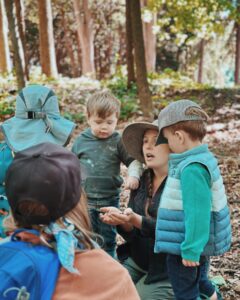
Jacqueline Anderson shares the wonders of local wildlife with young students during Playdate with the Woods.
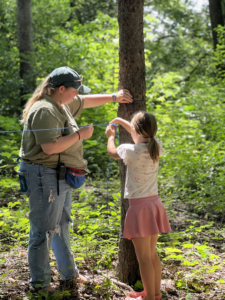
Amanda Losness-Ross teaches a camper the art of knot-tying during Nature class at Camp Adler.
THE IMPORTANCE OF COMMUNITY SPACES AND THE IMPACT OF DEFUNDING WOODS & ARTS PROGRAMS
Anderson’s development of programs like Playdate with the Woods, which has been on pause due to the grant forfeiture and new lease terms, has been foundational to the restoration of our woods. “I’m just so proud and grateful to have been able to spend time here in the woods. There are certain places that you walk into, and you [know] that [it] was loved by many people. You can feel that here in the way that certain things are designed.”
When I asked both Losness-Ross and Anderson what the grant forfeiture and new lease terms meant to them, their answers were unanimous.
Losness-Ross emphasized how losing out on the grant and defunding arts institutions is a loss of humanity and has resulted in a loss of knowledge from field experts. “One of the most human things we can do is to make art,” says Losness-Ross, who sees the public spaces like the center and the woods as opportunities to create a healthier environment and a greater sense of community. “When we have these natural green spaces where [people] do not have to pay to be a part of an experience, subscribe to, or pay for parking, and they are just able to come and experience, people will come.” From these communal spaces comes education and resilience.
Anderson reflected on the fact that woods programming has helped young people develop an appreciation and responsibility towards the woods. “Children have learned to really understand what stewardship and connection to place can mean. I think that’s something that is being lost. I don’t think that there’s any other place that does such a fluid connection to art and music and to land.” She sees woods education as a means of facilitating relationships and pushes back against the notion that nature is supposed to be untouched by humans.
The belief that we, as humans, are separate from nature has been instilled in many from a young age. Losness-Ross grew up with that ideology in Boise, Idaho where it was necessary to learn about the human impact of being present in the wilderness and the principle of “leave no trace.” She then moved to Lake County and was shocked by the abundance of fertile land, the ability to garden and forage, and the fact that this environment isn’t as fragile as it is out west. Through this change in geography, she learned a lesson that she now shares with her students: that they are a part of nature and that they deserve to be part of it. “There is this decades-long separation of people and nature, and it’s really easy to forget that we’re a part of it when we are in climate-controlled environments,” Losness-Ross explained.
The Des Plaines River by Milwaukee Trace used to be a large native trading post where people held a deep relationship with using and maintaining the wilderness. “This place has always been cared for by human hands,” explained Anderson. “To backtrack on all the work that has been done, all of the care and love that’s been poured into this area by so many different groups, is really sad and frustrating.”
A huge way to address this backtrack is by getting people out in natural spaces and educating them on how to maintain the land that makes up their home. Losness-Ross shared that the biggest thing that we can do for kids is to show them their place in nature and its inherent value. “Knowledge makes things a lot less scary, and then when it’s less scary, they’re more willing to be a part of it and protect it.”
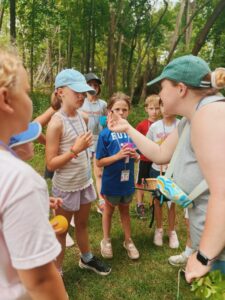
Amanda Losness-Ross teaches campers to recognize mulberries while exploring how people and wildlife have relied on them for generations.
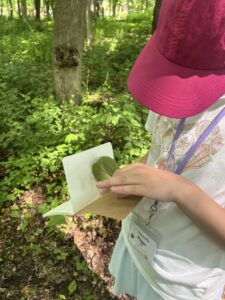
A Camp Adler student identifies a native leaf before using it to create natural prints and markings.
ADLER’S ESSENTIAL CONNECTION BETWEEN THE ARTS AND THE WOODS
Despite woods education being vital, it isn’t the norm for most children in America. Kids involved in woods education through the center have a unique educational experience as the woods are both unique in geography and history. With rare species of plants and animals that aren’t found in other parts of Libertyville, both Anderson and Losness-Ross have expressed how excited the kids get when they see new kinds of plants, frogs, and snakes amongst others. They also explored the connection between the historic building and the woods in the creation of personal and community-based art.
“I think that all art is connected to place,” Anderson expressed. “And if it’s not, then there’s something missing. Just being here, knowing the river, knowing the space in some capacity helps children to tie art to where they are [and build culture]. That’s something that we can miss in the United States sometimes.”
Losness-Ross sees the woods as a source of inspiration. “I think people make more beautiful art when they have something really inspiring to look at. When I’m going to look out the window to be inspired or find peace or daydream about something, looking out into something as beautiful as the woods here is more inspiring.” She went on explaining that nature is a huge part of her thinking process, photography, and drawing. When reflecting on the wishes of the Adler house, she expressed that the building and the woods were always supposed to be together. “I think we [should] do the intention of what the original owners wanted [and] fulfill their vision by keeping them together.”
As our lease agreement has changed, so too has our relationship with the woods. While we remain committed to stewardship, uncertainty surrounding our role has made it difficult to continue the restoration and maintenance efforts that have long been part of the Adler Arts Center’s work. Until there is greater clarity, much of that work has remained on pause.
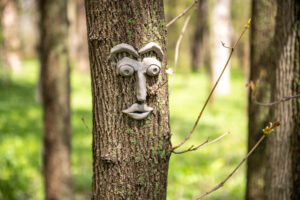
A clay face, created during our Earth Day Volunteer Event, now watches over the woods.
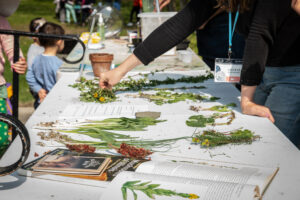
Volunteers learn to identify the native plants that help our woodland ecosystem thrive.
WHAT CAN WE DO TO HELP OUR WOODS?
Both Anderson and Losness-Ross expressed frustration at the inability to take care of the woods in the ways that they have done in the past by maintaining ever-growing invasive species populations. “This wood is a fantastic example of what happens and what invasive plant life can do to a landscape, how fast it can take over, what it can do to the water table, [and] how it can diminish or completely eradicate native flora and fauna.” Losness-Ross expressed that there is a right and wrong way to remove invasive species while reintroducing native species, and without proper woods education and restoration efforts, native life gets choked out.
When asked what we can do to restore, maintain, and take care of the woods here despite recent changes, Anderson suggested gaining hands on experience by getting involved with local forest preserves and volunteering in community groups. She also recommended expressing concerns to those who have the power to enact change on a structural level. “I think that one of the things would just be to talk to public officials and make it known that that’s important. In our last mayoral campaign, there was not one thing that came up about the environment. In Libertyville, it’s still not something that’s really talked about. Maybe because we’re in the Midwest and people have this idea that we’re going to be okay, but we’re not.”
“It’s very easy to ignore climate change in a place next to the Great Lakes.” explained Losness-Ross. “Out west, it is in your face. The heat, the droughts, the fires. And you must be very blind to ignore the immediacy of climate change when you’re living out there. When you can physically [see that] there is no lake. When the rivers are dry and the fires are coming down the mountain, you can’t ignore that. I think climate change is rearing its head a little bit more these days with our tornadoes and the rise of ticks, but it’s fertile out here. We can still grow our own things, and we have the water and the resources to take advantage of that. That’s a huge gift. It’s a crazy gift.”
Losness-Ross suggested properly disposing of garbage, especially in natural spaces, composting our food scraps, avoiding harsh chemicals on our lawns, turning to professionals and researchers for guidance on sustainable practices, and practicing mindfulness when taking from the environment. She also suggested making a goal of learning about two new plants a week to gain knowledge about both our native and invasive species.
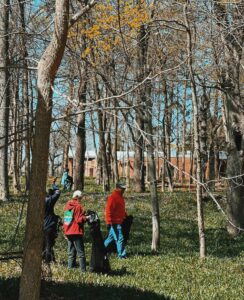
Volunteers of all ages work together to clean the woodland.
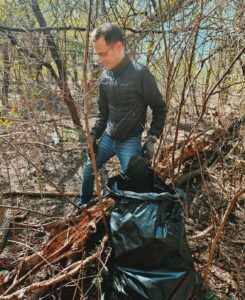
A volunteer removes litter from the woods.
CLOSING THOUGHTS
Though the loss of funding and new lease terms have taken away woods restoration efforts, conversations with people like Losness-Ross and Anderson who are actively working toward creating a better future for our community can show us that trying to advocate for a better world is not futile. As I close out this post, I look back on how the building transformed during the Camp Adler season. The sounds of tiny shoes thumping through the halls and excited, overlapping chatter and shrieks filled the building each day. The grounds were transformed as well, as campers in our nature classes pulled invasive plants and helped restore the accessibility of the walking paths. With few opportunities for restoration, their work provided a much-needed reprieve for the health of the woods.
Camp Adler is one of the center’s clearest examples of how the arts and the woods enrich one another. Throughout the summer, children discovered that if they belong in nature, they belong anywhere. With that confidence, they took risks in their art and brought ingenuity to everything they created. They learned that they can make lasting changes and developed the skills to build a more sustainable, regenerative, and creative world. People of all ages in our community need that now more than ever.
To continue making this possible, we must fund arts and nature programs. We must care for this land as it has been cared for for hundreds of years. In doing so, we protect not only a place, but the wonder, creativity, and belonging it inspires.