

december 16, 2025
Walls That Speak — Chicagoland’s Social Justice Art Scene
By: Paulina Moran
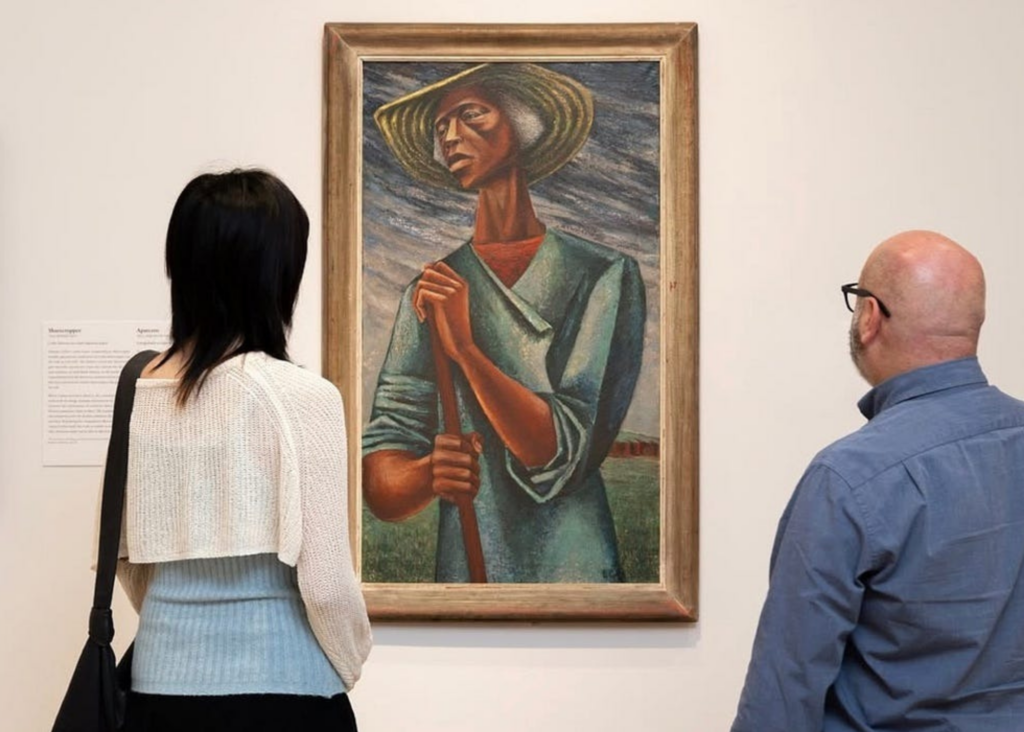
Elizabeth Catlett “Sharecropper” 1946
From Lake County to The Loop, we are witnessing art act as a language for the stories we struggle to speak. Across 40 miles of shoreline, artists are weaving together pieces of our collective history and illuminating faces that are often pushed to the margins, are revealing a growing movement in the Midwest and how art can act as a catalyst for social justice.
Tucked in downtown Waukegan, 9 miles East of The Adler Center, is The Dandelion Art Gallery. The Lake County gem is presenting ‘We the People, ’ a community-centered exhibition on display until December 31st. Touching on themes of identity, belonging, and the human experience in the United States. The core message is that the American identity is inherently plural, with the exhibit including portraits of individuals of different genders, races, cultures, and national origins. Highlighting how diversity is what defines modern America and extinguishes the belief of a single nation.
An hour South is the Chicago Justice Gallery in the heart of University Village. The exhibit ‘We’re Not All Here’ by Canadian, Chilean artist Soledad Fatima Munoz centers on loss and resistance. Using copper wire and cotton thread, Munoz documents the trend of missing black and Indigenous women. This series includes woven portraits, sound, and film projection, spanning from Chile to Palestine to Illinois. This compelling solo exhibit is an exploration of a collective loss and the human cost of violence, a topic especially urgent in a time of such repression, genocide, and dehumanization. This exhibit will be showing until August 2026.
A bus ride downtown will take you to the renowned Art Institute of Chicago, which is now showing Elizabeth Catlett’s ‘A Black Revolutionary Artist and All It Implies.’ Social activist and defining artist of the 20th century, Catlett pursued an art education in the 40s, where she witnessed class inequality and racial violence firsthand. Her work draws inspiration from African sculptures, German printmaking, and Mexican graphics to underscore the fight against racism, imperialism, and social injustice. The exhibit will be shown until December 31st.
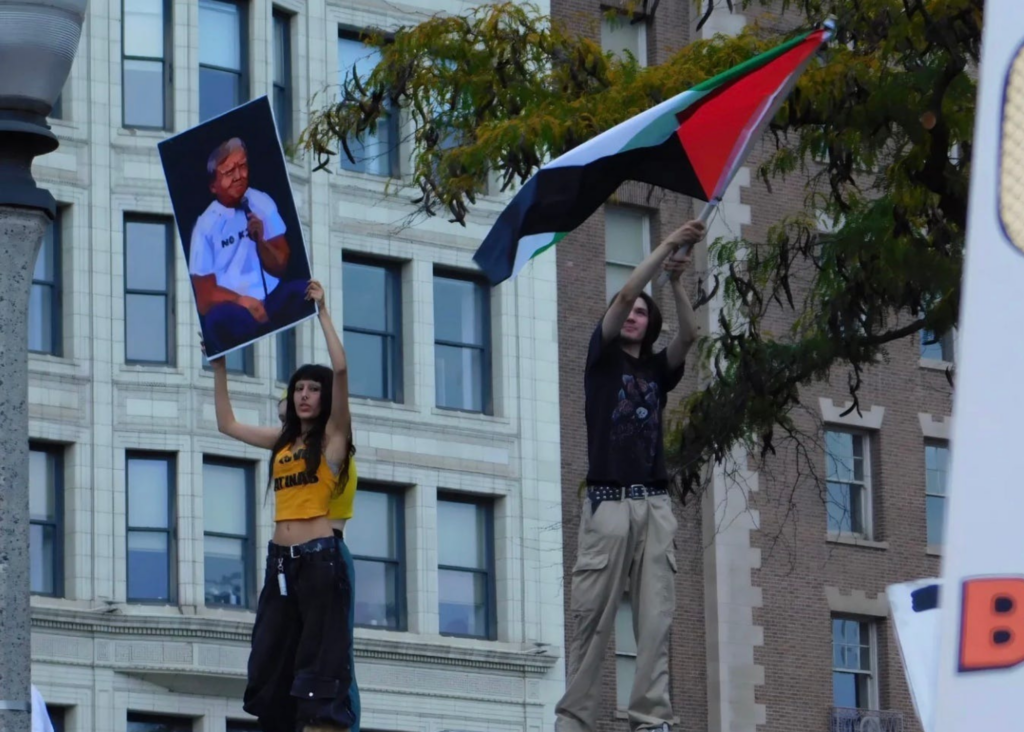
Protesters raise a Trump satire portrait piece and Palestinian flag, photo taken by my friend Shayne Holsman.
What This Movement Says About The State Of Our Nation
The current movements of Black Lives Matter, MeToo, and No Kings remind us that this is not a separate battleground or issues of the past, but ones unfortunately still alive and demanding engagement. Catlett was denied a U.S. visa in 1962 due to her political affiliation and activism, being publicly labeled as an ‘undesirable alien.’ She spent the remainder of her life in Mexico due to this.
Just as Munoz’s exhibit highlights how violence against women is not something distant or foreign, but close to home. The transnational framing of Chile to Palestine to Chicago displays an interconnectedness in global struggles and how US violence contributes to patterns of repression elsewhere. In an increasingly polarizing world, these exhibits remind us that these structural issues are persistent and in need of urgent attention. They discourage feelings of apathy by exhibiting real instances of erasure and violence. They are not simply of the past but alive and demand engagement. Art communities such as The Adler Center, Dandelion Gallery, and The Justice Gallery can provide safe spaces for reflection, conversation, and community.
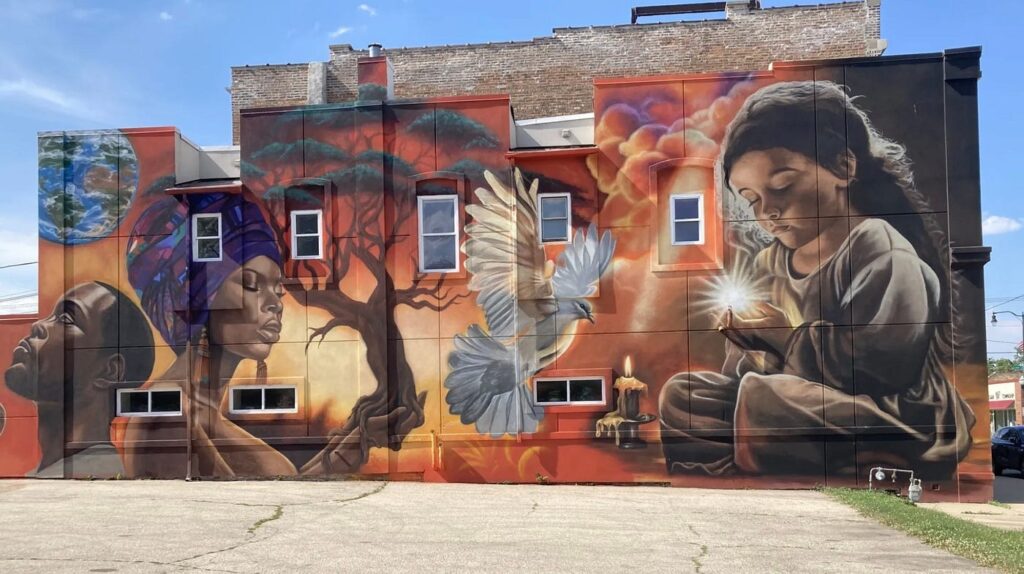
Waukegan mural marks downtown area of social services.
How To Incorporate Awareness Into Suburbia
It’s no secret that social justice-themed art struggles to reach beyond major urban cities. Suburbia is not necessarily culturally inactive but simply underserved. By creating access in suburbia, the impact will not only broaden its impact but also reach various audiences. Working at The Adler Center, I’ve witnessed the growing appetite for “non-traditional” exhibits and shows that are willing to speak out. This reveals the potential and responsibility in bringing in showcases that heal, challenge, spark, and transform. The prodding question is: What are tangible ways to begin?
- Community Storytelling: Sharing your history or experience does not have to be formal or performative. Storytelling can unfold in comfortable and intimate spaces with the people already around you. Start small, begin a discussion with friends, family, or neighbors. From there, begin organizing on a school or college campus. If you’re feeling called for more of a leadership role, consider hosting a community meet up at a local cafe, library, or park. These spaces are low-pressure environments for those who may be curious but not ready to commit. Potential topics could include the history of social justice art, identity, belonging, and what it looks like to take action in everyday life.
Start Here: Host a memory night! Gather a group where each attendee brings an object, photo, story, or a statement regarding a current social issue their facing or something their ancestors went through. Use these items as an entry point to discuss, reflect, and unpack. This practice not only strengthens ties with your community but also helps bring awareness around shared struggles. (A topic specifically related to our region is: Indigenous sovereignty in Lake County and the north shore.)
This can be especially helpful now for community members who have been affected by the government shutdown and are facing the threat of deportation.
- Artist Talk: Last month, my school hosted award-winning writer Anthony Joseph to give a guest lecture to the student body. He was incredibly vulnerable while reading his work. Offering background on the generational trauma packed behind these profound poems. His collection guides readers through the journey of growing up in Trinidad, then moving to the UK, and the recent erasure of Caribbean culture. His discussion ranged from his ancestors’ history of colonialism and slavery to ongoing issues like globalization and the absence of cultural representation in mainstream narratives. During the Q&A portion, almost every hand in the auditorium was up — hungry to learn more.
A quote he left the audience with before departing was, ‘The beauty of the valley does not take away the sorrow of the past.’ This line comes from an interview conducted in Trinidad, where he and the journalist were looking out over the island landscape. The statement captures a profound truth: Although the island has progressed greatly, there is still history that needs to be acknowledged and made known.
Beauty and grief can coexist; honoring the past is necessary to understanding the present.