

december 8, 2025
Beyond Boundaries: The Art of Becoming for Cosmo Dalton and Azul Alberto Nogueron
By: Paulina Moran & Ellen Williams
In Smash the Cis-tem, the current exhibition at the Adler Arts Center, two artists anchor a powerful dialogue on identity and becoming. Sculptor Cosmo Dalton and painter/light artist Azul Nogueron Alberto work in distinct mediums, yet their creative currents run parallel – each confronting shame, reclaiming personal narrative, and illuminating the delicate terrain where innocence, sensuality, faith, and transformation converge.
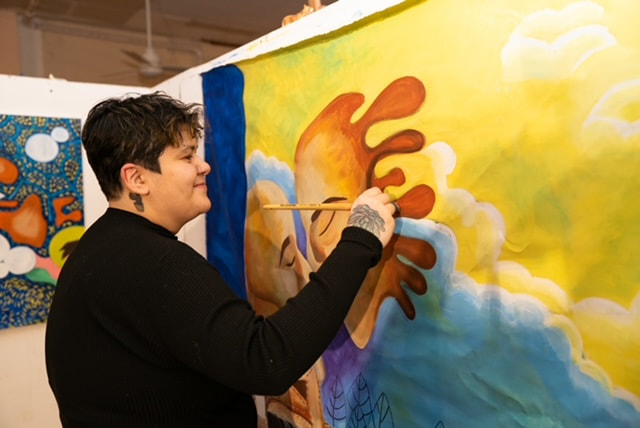
Azul Alberto Nogueron in their studio. Photo from their website, azulnogueron.com
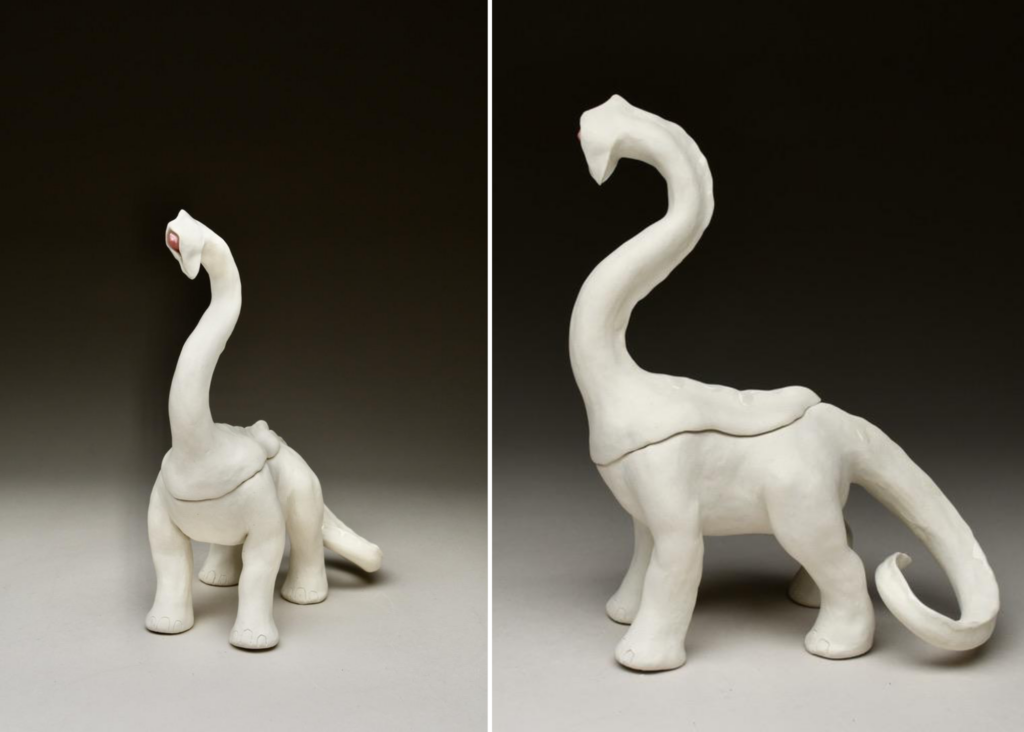
“Clitsaurous” by Cosmo Dalton
Childhood, Inheritance, and the Bodies We’re Told to Ignore
Cosmo, a second-year sculpture student who only began working with clay two years ago, gravitates toward childhood symbols – chiefly dinosaurs. “They were my earliest love,” Cosmo reflects. “My mind wanders back to cartoons: vivid, round forms, oversized expressions.” This nostalgia sets the stage for the unexpected. Their dinosaurs don’t have conventional heads; instead, they bear soft, visceral “vaginal heads” that provoke confusion, curiosity, and often denial.
“People ask if I’m giving it a head,” Cosmo laughs. “The head is already there. They just refuse to see what they don’t want to.” They note that this refusal isn’t unique – Georgia O’Keeffe faced the same disbelief when viewers insisted her floral abstractions had nothing to do with anatomy. Cosmo’s response is both simple and disarming: “It’s a vagina.”
This bluntness is not for shock value but for reclamation. Their sculptures embody the changes experienced by transgender bodies – anatomy that defies both medical diagrams and cultural narratives. “Medical illustrations are overly idealized,” Cosmo says. “No one is symmetrical or static. My anatomy is correct.” Their work challenges viewers to confront the body as it truly exists: personal, particular, fluid.
Faith, Grief, and the Holiness of Ambiguity
For Azul, whose paintings and light installations glow with surreal, saturated color, questions of identity were once spiritual crises. “If queer people have always existed,” they wondered as a child, “why aren’t their stories in the Bible?” Growing up in church, baptized eleven times in an attempt to wash away unnameable shame, Azul spent years believing they had to exist in a fixed, sanctioned way to be worthy.
Yet their art reveals a profound liberation. Their canvases often stage Catholic iconography—halos, immaculate hearts, veils, candles—alongside nudity, queer lovers, and defiant displays of embodiment. Some call it blasphemy; Azul calls it truth.
“The spirit is nonbinary,” they say. “The body is a vessel of holiness, alive with emotion. Gender won’t matter when we’re dead.” Their work becomes a map of grief and rebirth, a place where their old self dies and their new self speaks. It is also, quietly and tenderly, a love letter – to their partner Kelso, and to the many versions of themselves that struggled to belong.
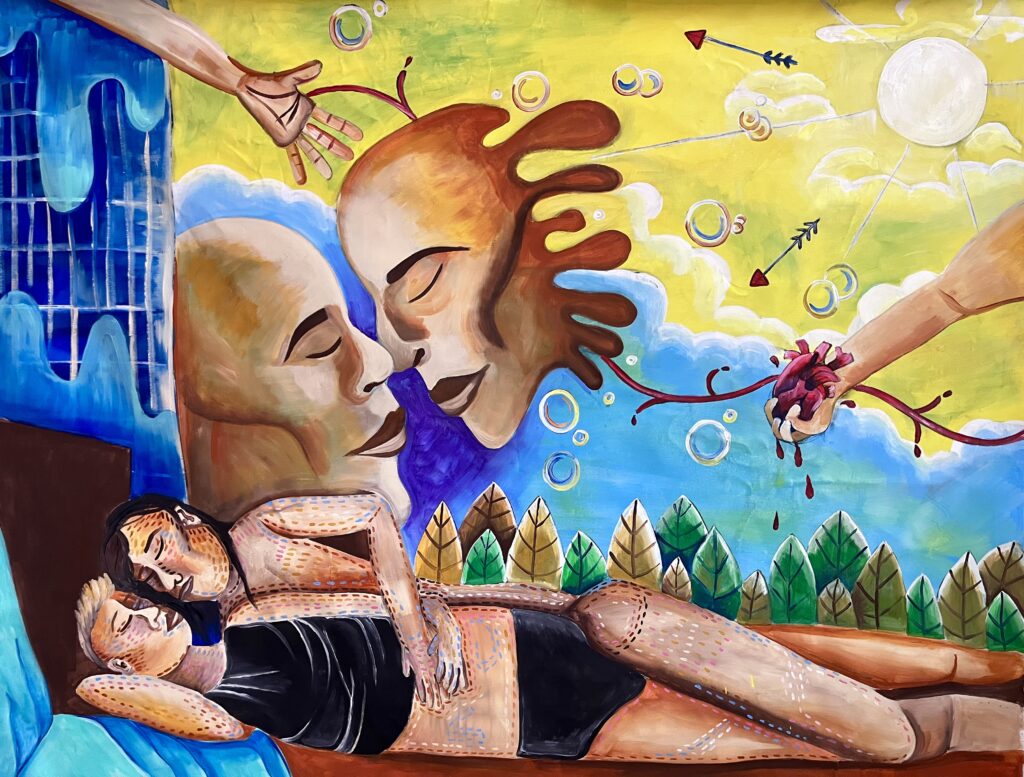
Hold You in my Arms (Sparks) 60 x 72 Acrylic on Canvas by Azul Alberto Nogueron
The Power of Seeing and Being Seen
Both artists navigate how society, and especially children, learn shame. Cosmo notices how easily kids approach their sculptures. “They run up yelling, ‘Look, a dinosaur!’” they say. “The parents freeze. They’re deciding whether this is a moment of innocence or information.” For Cosmo, the answer is simple: the two can coexist. Children mirror our cues. If we teach them the body is dirty, they carry that with them.
Azul echoes this in another register. Through emotional color synesthesia, they feel hues as sensations—reds pulsing with passion, blues humming with serenity, yellows warming like sun on skin. Color becomes a language beyond shame, a way to communicate experiences that once felt unspeakable. “To truly love is to understand grief,” they say. “And to hold grief is to know love existed.”
Art as Permission
What binds Cosmo and Azul is not medium, aesthetic, or even subject matter, but intention. Both create art that unsettles, invites reflection, and disrupts inherited scripts about identity, gender, and spirituality.
Cosmo wants viewers to ask themselves: Why does this disturb me? Is it my feeling—or a feeling I was taught to have?
Azul wants viewers to understand that identity is not a rulebook but a living testament to what emerges when we release the fear of crossing boundaries.
Together, their work forms a conversation about bodies, faith, childhood, and the courage required to question what we have been told is absolute. They remind us that becoming ourselves—truly, fully—isn’t an act of rebellion. It’s an act of honesty.
And in their hands, honesty becomes art.
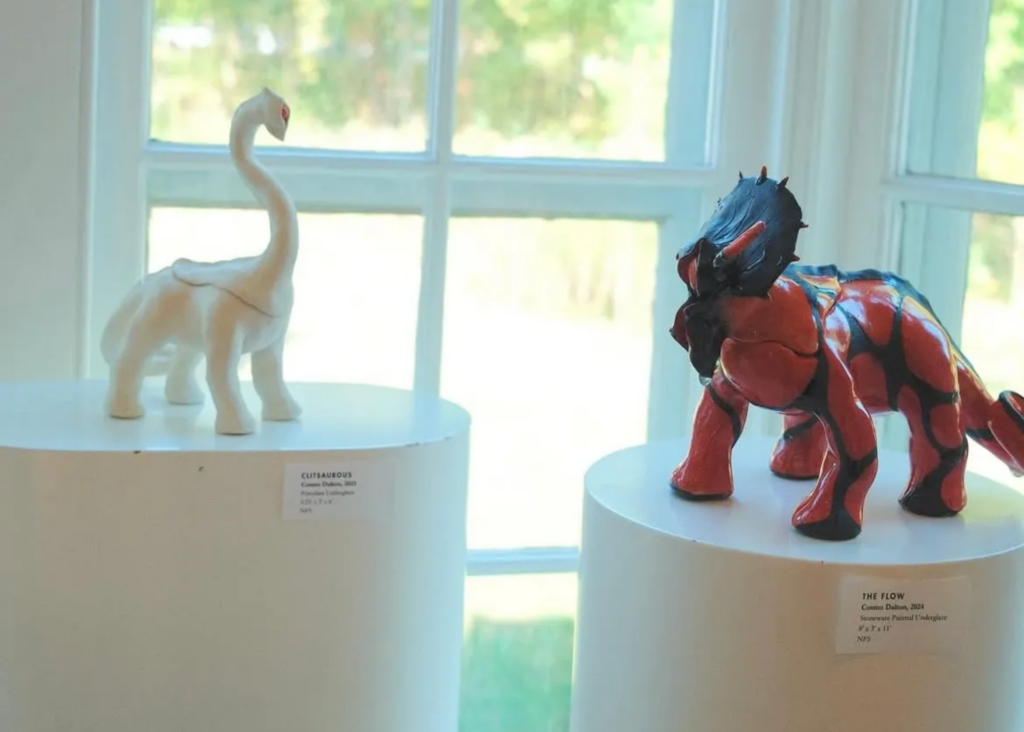
“Clitsaurous” & “The Flow” on display at the Adler Arts Center through December 13th.
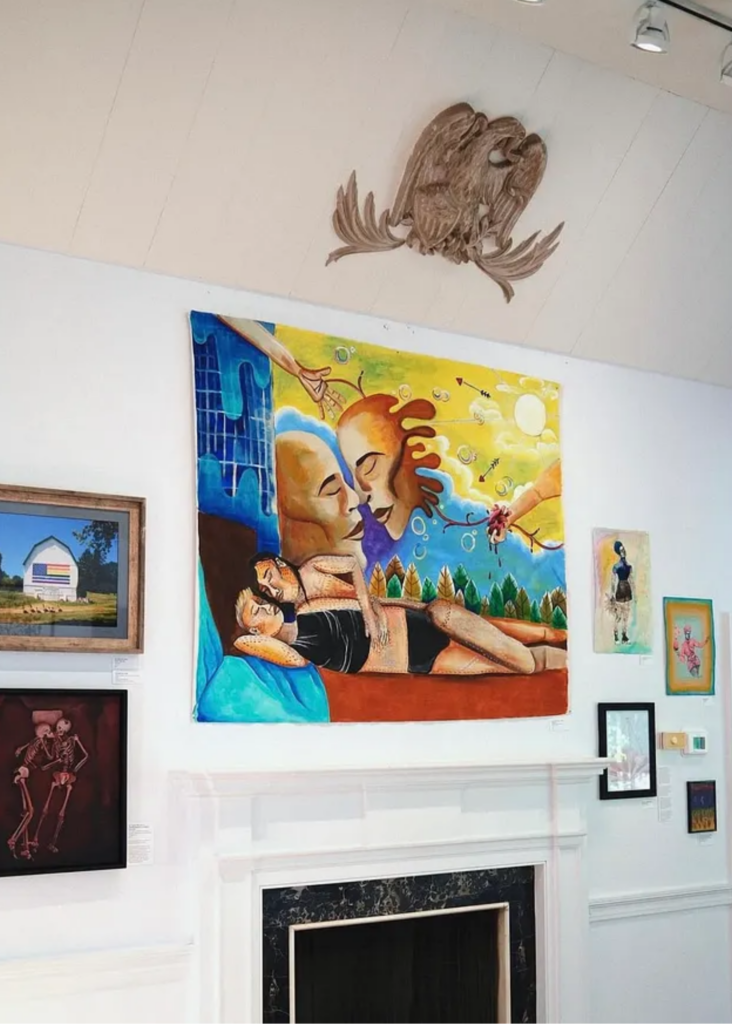
“Hold You in my Arms (Sparks)” on display at the Adler Arts Center through December 13th.