

september 11, 2025
The Light That Remains: Jean-Michel Frank at the Adler Center
By: Ellen Williams
Every day, students carrying instruments, teachers balancing armfuls of supplies, and visitors stepping into this historic house walk beneath a chandelier and pass bathroom sconces without a second thought. They cast their light quietly, illuminating hallways and rooms where lessons unfold, exhibitions are on display, and neighbors gather. To most, they are simply fixtures. But in truth, these are rare works by Jean-Michel Frank, one of the most visionary designers of the twentieth century, and their presence at the Adler Arts Center is part of a much larger story.
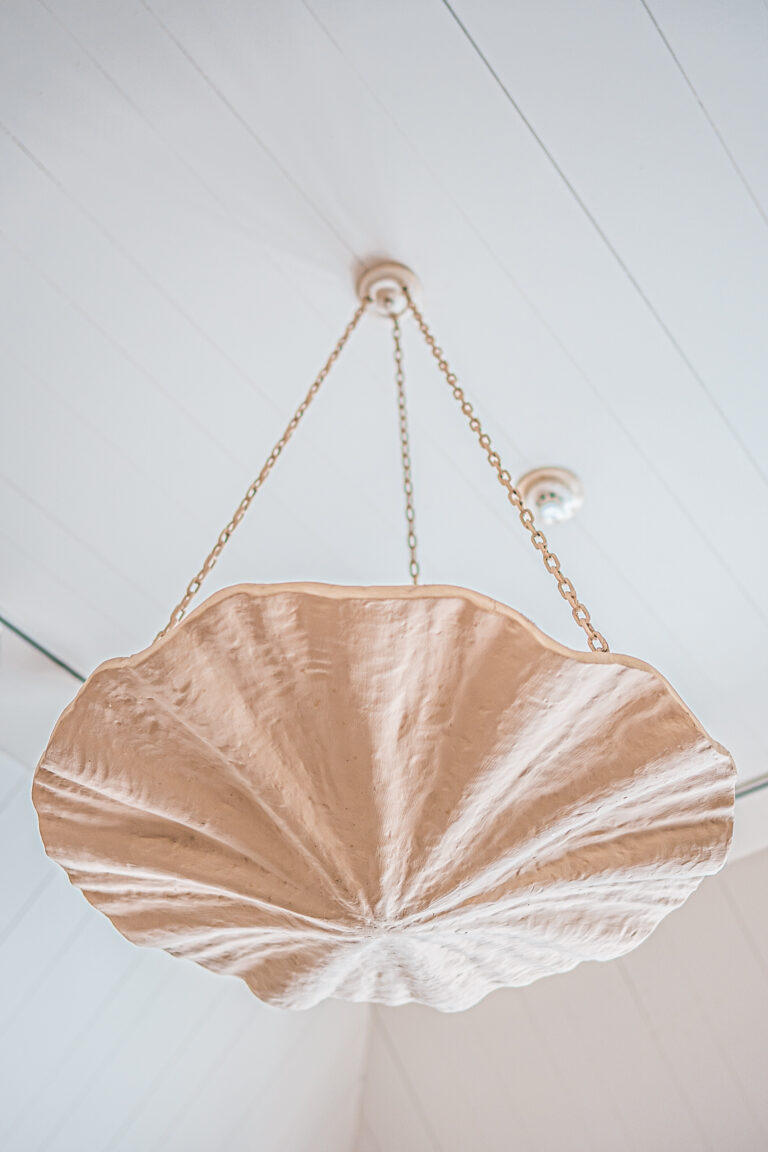
Jean-Michele Frank ‘Patelle’ chandelier
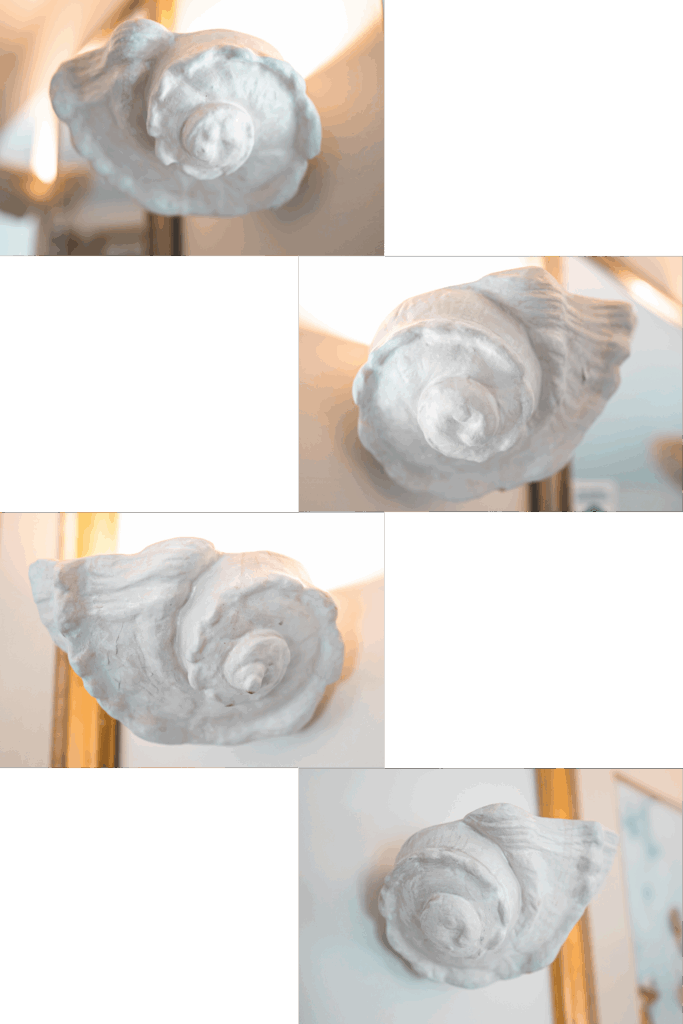
Jean-Michele Frank ‘Escargot’ Sconces
Frank’s name may not be as familiar as Picasso or Dalí, although he collaborated with both. Yet among designers and collectors he is revered as a poet of interiors. His genius lay in creating spaces that were stripped down yet sumptuous, minimalist yet deeply textured. He favored parchment, shagreen, mica, and straw marquetry, turning humble surfaces into refined statements. He believed that silence and restraint could be as powerful as ornament. A room by Frank could feel serene, almost monastic, and then be punctuated with a lamp or console that demanded a second look, often designed with his collaborator Alberto Giacometti. Their objects blurred the line between sculpture and function, inhabiting a liminal space between art and utility.
The chandelier and sconces here at the Adler Center are examples of that philosophy. The chandelier ripples like a seashell suspended in air, while the sconces coil like shells caught mid-spiral, their plaster surfaces uneven and luminous. They illuminate, but they also suggest fragility and endurance. They ask us to notice light not just as a necessity but as an atmosphere, a metaphor, even a memory. For those who pause long enough to see them, they carry the essence of Frank’s genius: the ability to make the everyday profound.

Jean-Michele Frank
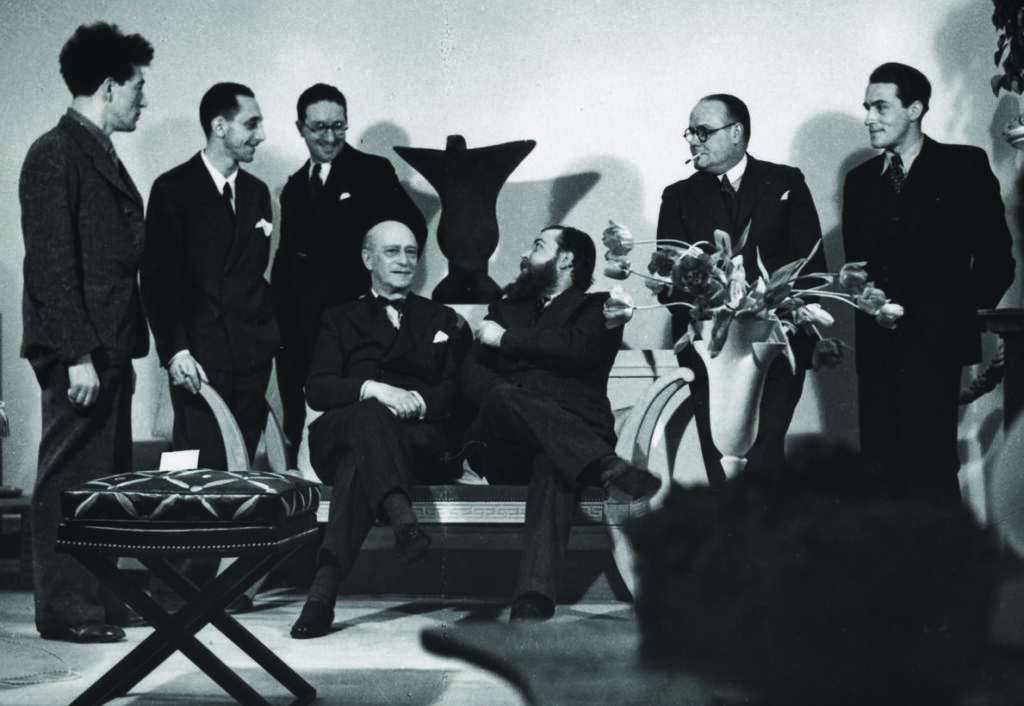
Paul Rodocanachi (seated in the center) with (from left to right) Alberto Giacometti, Jean-Michel Frank, Emilio Terry, Christian Bérard, Adolphe Chanaux , & Diego Giacometti , by François Kollar
Jean-Michel Frank was born in 1895 into a prominent German-Jewish banking family. His cousin was Otto Frank, the father of Anne Frank, whose diary remains one of the most enduring testimonies of the Holocaust.(1) Both men came of age in families that valued refinement, education, and culture, and both endured the dislocations of exile as Europe was torn apart by antisemitism and war. Jean-Michel’s path was shaped by beauty, but also by profound loss. As Nazism spread across Europe, he fled Paris, first to Buenos Aires, where he worked with Comte to bring his aesthetic into Argentine homes, and later to New York.(2) Though he continued to design, creating interiors and objects that won admiration from patrons and peers, the weight of grief and displacement never left him. In 1941, at just forty-six years old, he died by suicide in Manhattan.
To understand Frank’s work fully, we must also recognize his queerness. In an era when homosexuality was stigmatized and persecuted, Frank lived as a gay man within elite artistic and social circles in Paris. His identity shaped not only his private life but also his creative vision. Frank’s interiors often balanced restraint with a subtle sensuality, a constant tension between clarity and mystery that mirrored the coded ways queer artists of his generation expressed themselves.
He belonged to a broader community of queer creatives — artists, writers, and designers who gathered in salons and ateliers, crafting spaces where difference and desire could coexist more freely than in the world outside. Frank’s friendships with figures such as Christian Bérard, Salvador Dalí, and Alberto Giacometti placed him within a network of avant-garde thinkers for whom identity and artistry were inseparable.(6)
That Frank’s life ended in exile, carrying the twin burdens of antisemitism and homophobia, makes his surviving work all the more poignant. His designs are not simply exercises in minimalism; they are expressions of a man navigating multiple marginal identities in a world that too often sought to erase them. To see his chandelier and sconces shining here in Libertyville is to honor not only his artistry but also his queerness, his resilience, and the courage it took to create beauty under such weight.(7)
What remains are the objects, and they continue to speak. Today Frank is recognized as one of the great innovators of twentieth-century design. His pieces are treasured in private collections and museums, and their values at auction soar, but their true worth lies in their enduring modernity. They look as fresh now as they did ninety years ago, reminders that restraint can be as radical as extravagance.(3)
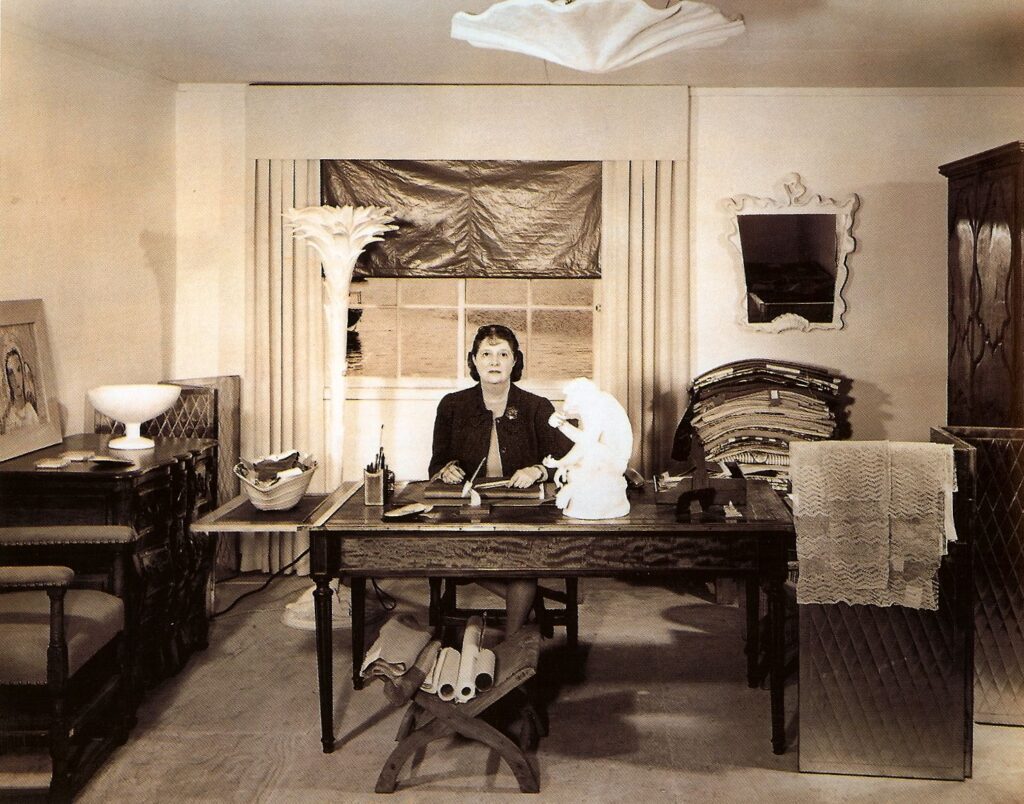
Frances Adler Elkins in her office alongside Jean-Michele Frank works
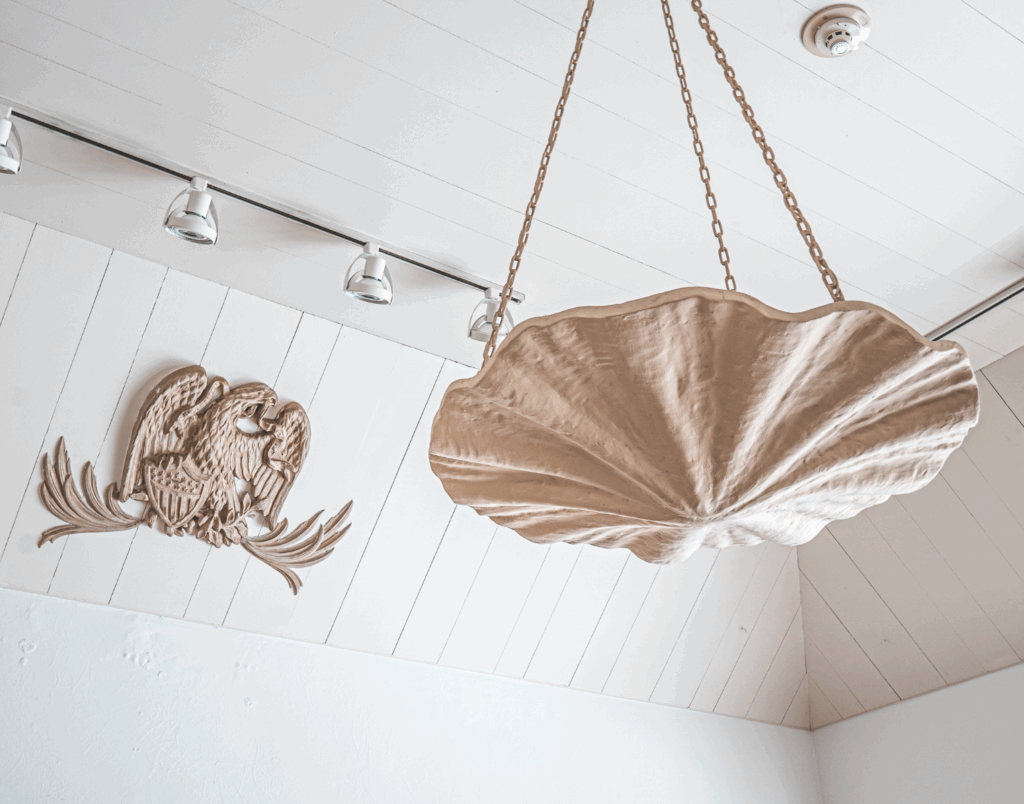
Jean-Michele Frank ‘Patelle’ chandelier, Adler ballroom, present day
It is through Frances Elkins that Frank’s voice echoes here at Adler. The younger sister of David Adler, Elkins was one of America’s most daring interior designers. She shared Frank’s belief that objects could carry poetry, and she championed his work long before it was widely known in the United States. Elkins sought out his furniture, his lighting, and his collaborations with Giacometti, bringing them into American interiors where they conversed with classical architecture and antique furnishings.
The chandelier and sconces that still hang in the Adler house are part of that story. Elkins introduced them not as decorative flourishes but as living testaments to a new aesthetic. By setting Frank’s Parisian modernism into the fabric of Midwestern domestic life, she ensured that his radical simplicity would find a home far from Europe, and she preserved a fragment of his legacy for future generations.(4)
When I stand beneath these pieces I think of the layers they hold. They are vessels of design genius, of Jewish resilience and tragedy, of Frances Elkins’s boldness, and of the Adler family’s devotion to art. They remind us that even objects as practical as lamps can carry poetry.
It is easy to walk into this house and notice the grand architecture, the symmetry, the elegance of crown moldings. But sometimes the most powerful stories are told in smaller, quieter forms. A chandelier, a pair of sconces, a shell of plaster that holds light in its curve.
To see these objects not just as functional but as profound is to honor Jean-Michel Frank’s gift to the world. It is to recognize that art does not only live in museums or on grand stages, but in the rooms we inhabit every day. And it is to acknowledge that behind every object lies a life, sometimes brilliant, sometimes broken, but always worth remembering.
Here at the Adler Arts Center the light that Frank shaped still glows. It reminds us that beauty can survive displacement, that memory can live in plaster and form, and that to notice the poetry of an object is, in its own way, an act of reverence.
Sources
- Comité Jean-Michel Frank. “Biography of Jean-Michel Frank.”
- Monterey Peninsula College Library. Jean-Michel Frank LibGuide.
- Carina Villinger, Sotheby’s. Jean-Michel Frank Provenance Notes and Consignment Information, 2024.
- JeanMichelFrank Sothebys offer letter.
- Powell, Scott. Frances Elkins: Visionary American Designer. Rizzoli, 2023.
- Lapham’s Quarterly, Emma Garman. A Space Where the Soul Could Go to Rest – On the Life and Work of Jean-Michel Frank.
- Lipsky, Bill. Jean-Michel Frank: Modernism, Minimalism, and Luxury. San Francisco Bay Times, 2020.