
August 1, 2025
Where Art Takes Root: Stories from the Festival of the Arts
By: Paulina Moran
The very first Festival of the Arts was held in 1981 on the front lawn of the historic David Adler Estate. It was a celebration born from revival. Just months prior, the same artists and volunteers who had rescued the neglected property from ruin were ready to share their vision: a community where creativity and culture were as vital as bricks and mortar. That first festival featured visual art, live music, and hands-on creativity and drew hundreds. By 1983, attendance had tripled. Today, Festival of the Arts is one of the longest continuously running art festivals in Lake County. And it all started at the Adler Center.
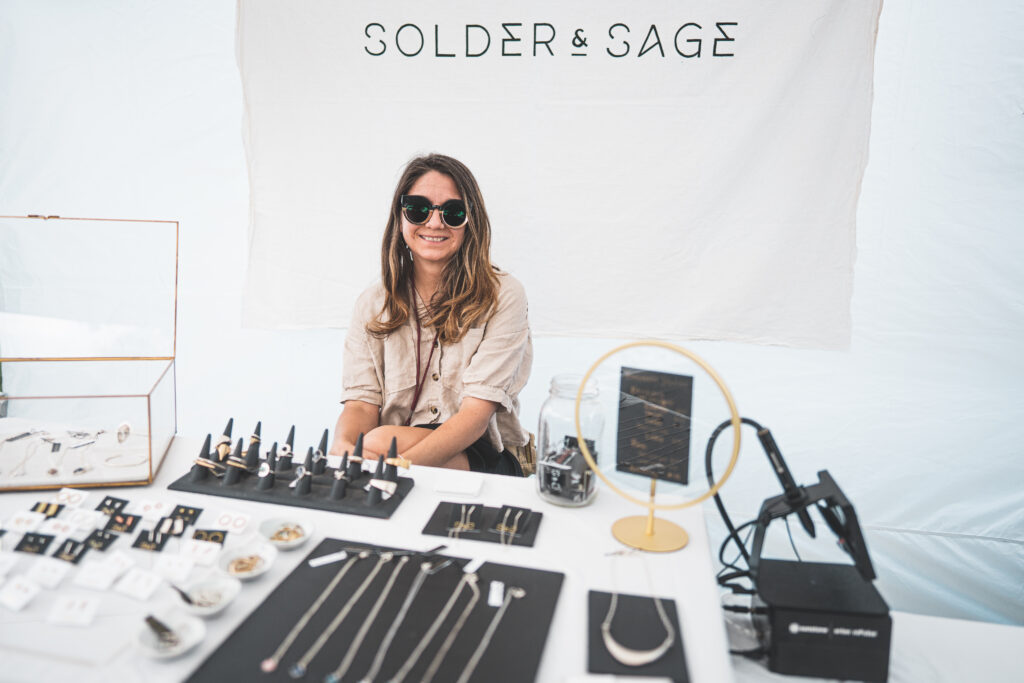
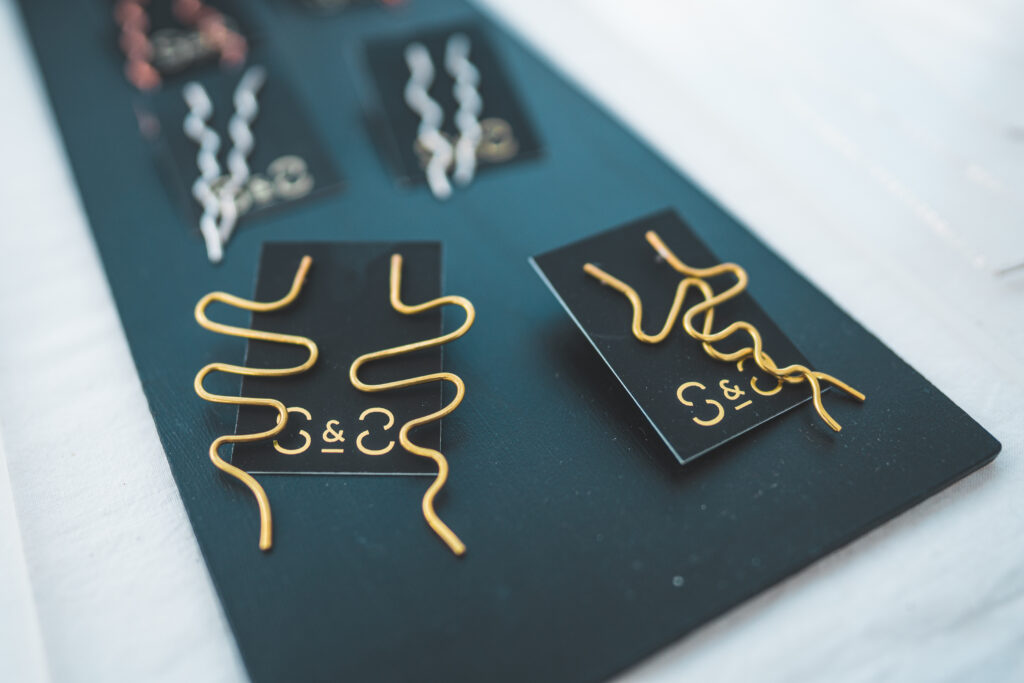
This legacy continues to shape and inspire artists who return year after year. One of them is Katy Froeter, founder of Solder & Sage, a handmade adornment apothecary built on the idea of setting daily intentions through art. Katy launched her business in 2012, and every single piece, whether a wax cast necklace or a hand-poured incense, is made by her, start to finish, in her Chicago studio.
When I sat down with Katy this past June, I was already intrigued. Her story felt like the plot of the next great indie film: marketing degree, years of corporate hustle, and then a leap. A leap into the unknown world of self-taught metalsmithing, entrepreneurship, and creative freedom.
“I realized I wasn’t very good at making money in corporate America,” she said with a grin. “If I was going to be poor, I might as well be doing a job I enjoy.”
Katy had always been creative. As a kid, her mom took community college art classes, so supplies were always on hand. By high school, her teachers were urging her to pursue art professionally. But like many, she first followed the “safe” path, corporate advertising. Eventually, the long hours and hollow hustle caught up to her. She remembered asking herself, when was I last truly happy? The answer was always the same: when she was blending art and business.
She returned to art through night classes in Chicago. “I had no idea what I was doing,” she laughed. “But the work I was producing stood out. It didn’t look like anything else on the market.” That intuitive, unpolished originality would go on to become her signature.
When I asked about the name “Solder & Sage,” she explained how the business started out as KFro Designs, a simple mash-up of her name. “No one really understood it,” she admitted. As she branched out beyond metalwork into incense, fine art, and spiritually rooted objects she knew she needed a name that resonated. “Solder & Sage – Be Authentically You” felt right. And clients agreed. The rebrand boosted both attention and sales.
Today, Katy curates her own workflow. She plans longer days ahead of festivals then rests once they’re over. It’s a healthier rhythm, one that honors her energy and creativity. Still, she doesn’t sugarcoat it. “There are days it feels like a job,” she admitted. “But I’d never go back.”
She encourages other creatives to take the leap too, though with realistic caution: save money, have a plan, and prepare for hustle. When asked why community support for the arts matters, she lit up.
“The arts bring color to life,” she said. “If you don’t have art, everything’s in black and white. When a town appreciates art, its architecture, its food, its landscape, it’s just more beautiful. People feel that.”
She calls Festival of the Arts her “hometown art fair,” and has won Best in Category for jewelry two years running. “I feel so welcomed here. Ellen at the Adler Center is a true champion of my work. Artists need more organizations like that, people who coordinate, curate, and build excitement. That’s exactly what Adler does, and we need more of it.”
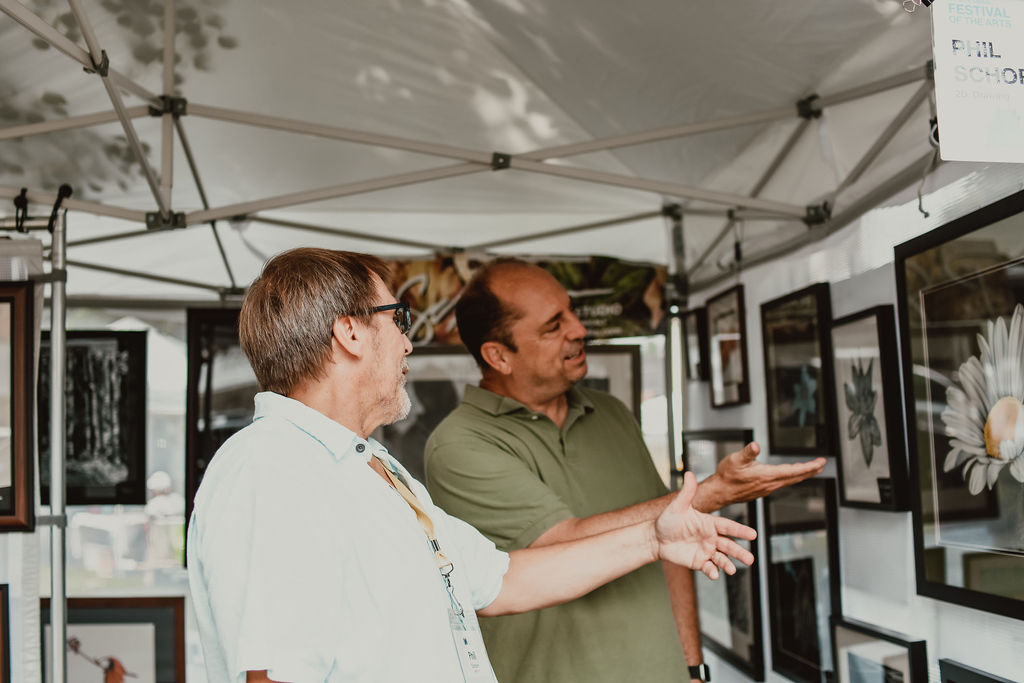
Another longtime participant who echoes that sentiment is Phil Schorn, a contemporary botanical artist whose detailed pencil renderings of nature have earned him the nickname The Master of Prismacolor. Like Katy, Phil’s journey into art wasn’t linear but it was always inevitable.
Phil double-majored in Commercial and Fine Art at Eastern Illinois University, thanks to a high school art teacher who spotted his talent early. “By sophomore year, I knew art was what I was going to do,” he told me.
After graduating in 1984, Phil’s first job wasn’t in a gallery, it was at Wendy’s. Eventually, he found work as a graphic designer in the direct mail industry. “The stuff you’d get in the mail, coupons and flyers, you’d throw them away, but I was the one designing them,” he joked.
Still, his passion for fine art lingered. A chance opportunity to judge an art fair in 2001 reignited that fire. But it wasn’t until 2010, on a visit to the Botanic Gardens with his wife Cathy, that he found the subject that would define his work: nature. She took photos. He turned them into hyper-realistic, soul-soothing portraits of leaves, blossoms, and branches.
“There’s less pressure in drawing nature,” he explained. “It brings me peace.”
His medium of choice, Prismacolor pencils, have soft cores that allow him to “paint with the pencil.” The result is rich, layered work that blends technical precision with emotional depth. Nearly half of his portfolio is dedicated to plant life, and you can feel the reverence in every line.
In 2018, Phil faced a cancer battle. He believes that art played a vital role in his healing and even helped him create some of his most profound pieces. Although treatment was intense, it didn’t stop him from teaching. He recalled how Adler staff would push him around in a wheelchair so he could continue running his classes. This November, he will celebrate seven years cancer-free.
I’ve had the opportunity to witness Phil in action while working at reception during his art classes. He has been teaching at The Adler Center since 2017 and teaches at The Gorton Center in Lake Forest. When describing his teaching philosophy, he shared an analogy that stuck with me:
“The student’s vision is the bowling ball and I’m just the bumpers, helping keep them on course. Instead of imitating me, I want them to pave their own path while incorporating the principles I have taught them.”
“I can be exhausted when I come in to teach an evening class but fifteen minutes in, I get re-energized because everyone is so engrossed in the material.”
When asked about the recent Village issues affecting the Adler Center, Phil didn’t hesitate. “There are a lot more artists and wannabe artists than you realize. They offer so much to the village. Don’t hinder them from pursuing something they’ve been dreaming about. Art is really what brings the community and businesses together here.”
His love for the Adler Center runs deep. “The Adler Center means so much to me. They gave me my start, really took a chance on me. At the time many people thought my medium of colored pencils was just a fad, it wasn’t taken seriously. Adler allowed me to present it as a formal form of art. They gave me the steppingstone to grow not only as an artist but as an instructor.”
Both Katy and Phil are a testament to the enduring spirit of the Festival of the Arts and to the deeper story behind every booth in Cook Park. These aren’t just vendors. They’re people who’ve taken risks, followed instincts, and shaped their lives around creativity. Their stories and their work remind us what this festival is really about.
It’s not just art. It’s the act of making something meaningful and having the courage to share it.